
Decades of Decay: Re-photographing Windy Harbour on Werneth Low
WERNETH LOWABANDONED
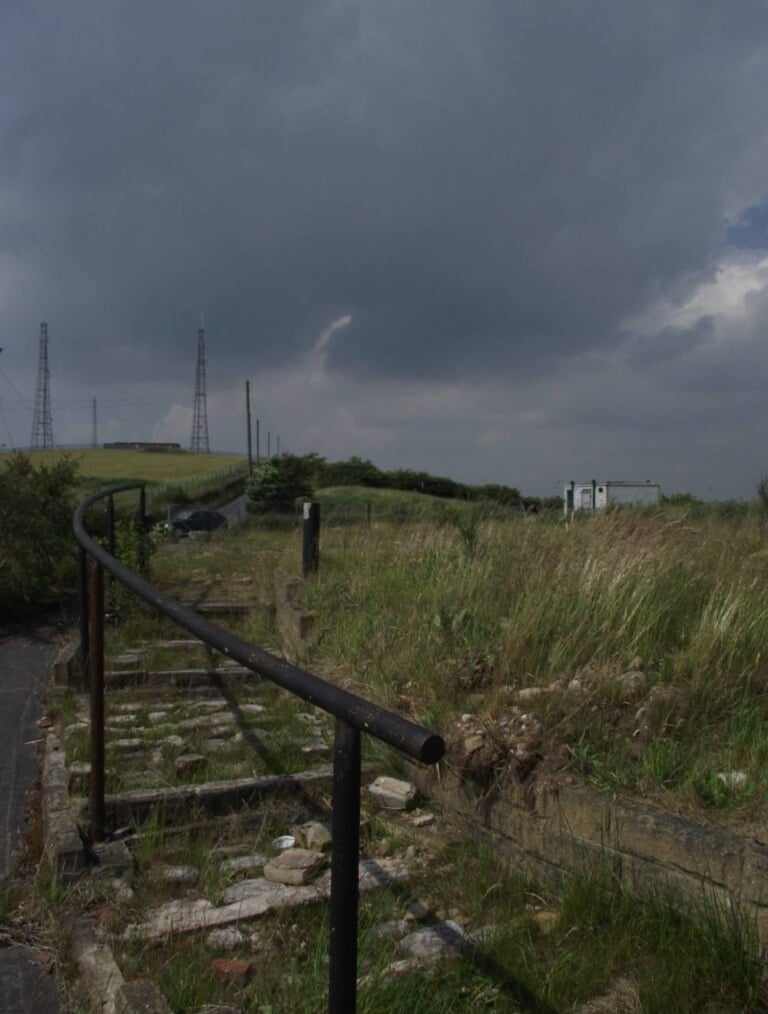
You wouldn't naturally think a derelict site could change that dramatically over two decades, but time and nature always win in the end.
This week, we took a walk up to Werneth Low, a country park that sits on the high border between Stockport and Tameside, offering sweeping views out over Greater Manchester and the Peak District. My goal for the walk was to revisit the abandoned site of the old Windy Harbour Restaurant—a place I hadn't photographed in roughly 20 to 25 years.
For anyone unfamiliar with the local area, Windy Harbour was once a popular venue perched high on the slopes of Werneth Low.
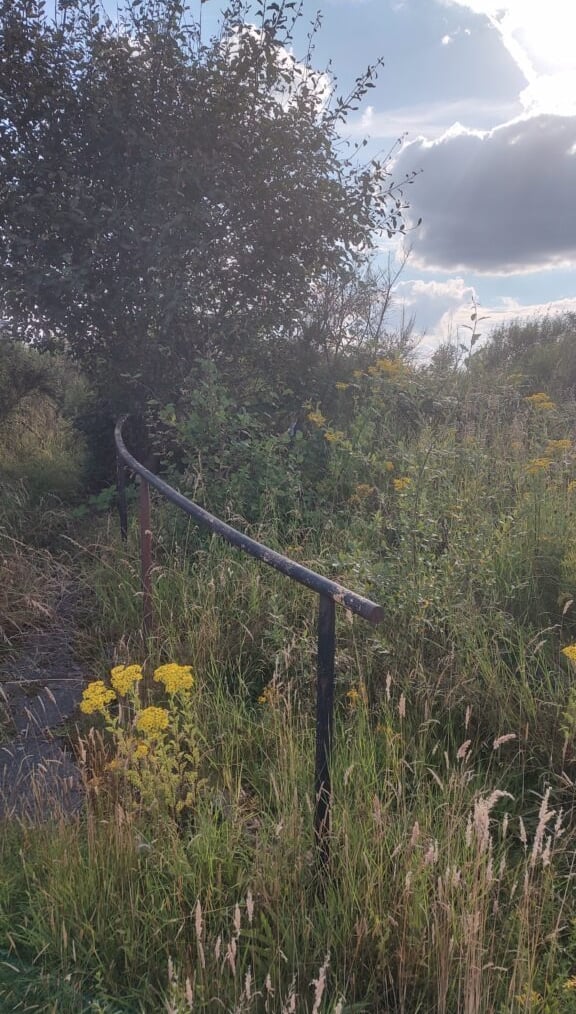
Trying to align a "then and now" comparison shot on location using a phone screen to cross-reference a two-decade-old photograph is surprisingly tricky.
In the original 2001 frame, the stone steps leading into the site were clearly visible, flanked by the surrounding hills and television relay aerials in the far distance. Returning this week, nature had thoroughly reclaimed the entire plot.
The distant radio masts that I hoped to use as visual landmark anchors were entirely blocked out by a mature tree that had grown up in the intervening years. In fact, if it weren't for the rusty, weathered metal handrail still peeking out through the thick undergrowth, it would be almost impossible to prove it was the exact same spot!
In hindsight, to get a closer match to my original composition, I probably should have dropped my camera angle lower and stepped closer to the railing. But seeing how violently nature overwrites human structures in just twenty years makes for a fascinating visual study in decay.
Photography Notes
Location: Werneth Low Country Park (Windy Harbour Site), Hyde, Greater Manchester.
Subject: Repeat Photography (Then & Now), Industrial/Commercial Ruins & Woodland Reclamation.
Mastering Re-photographing Historical Landscapes:
Match Focal Lengths: When attempting to recreate an old photograph, ensure you match the field of view 35mm vs 24mm of the original camera lens. Phone cameras often default to a much wider angle than older compact or SLR lenses, which distorts background proportions.
Find Non-Organic Anchors: Foliage, trees, and earthworks shift drastically over 20 years. Always look for permanent, non-organic visual anchors—like iron handrails, stone boundary walls, or geological rock formations—to lock in your tripod position.
Following its closure in 1998, the building sat abandoned and quickly fell target to decay. A devastating fire gutted the premises in 2000, leading to its ultimate demolition. Over the years, various planning proposals surfaced to redevelop or reopen the plot, but nothing ever materialized—largely due to local traffic concerns and the narrow, steep access lanes winding up the hill.
When I first photographed the site around 2001, the ruin's concrete structures and stone staircases were still starkly defined against the landscape. Re-creating that image today proved to be a far tougher challenge than I anticipated!