
Forgotten Pits and Shifting Ground: The Legacy of Bersham Colliery
COLLIERYBERSHAMMINE
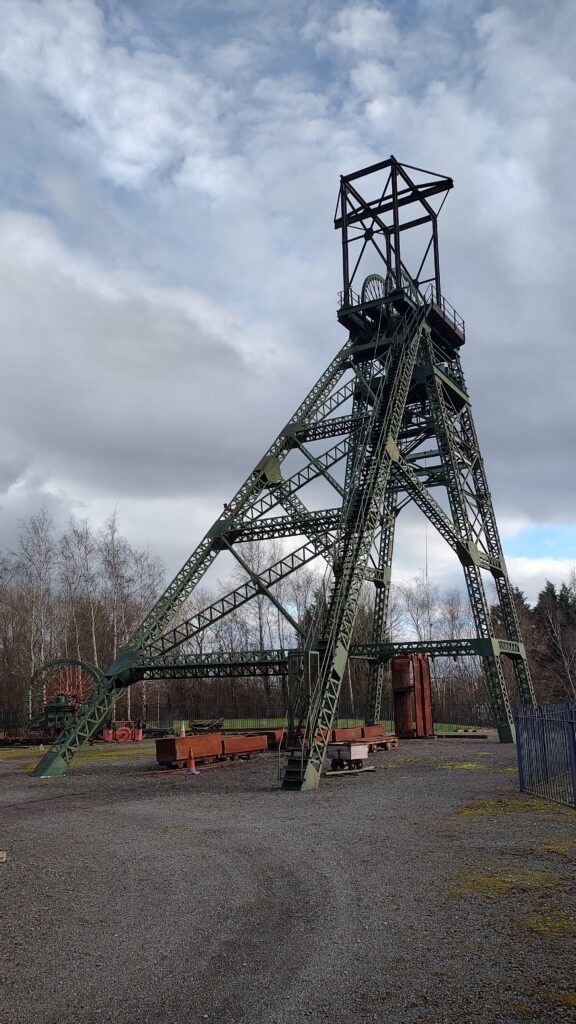
On our way to visit Erddig Hall, we passed a towering piece of industrial winding gear. It was instantly recognizable as a pithead monument, marking the site of an old coal mine. I naturally assumed it was part of an active heritage museum, but I later learned that after a significant amount of cleanup work and financial investment, the site was closed to the public because decision-makers deemed there was "not enough local interest."
To be honest, that reasoning feels entirely backward. Surely local interest isn't the primary metric for a heritage site—it’s out-of-town visitors you want to attract. I’ve personally taken museum tours down two different deep-pit coal mines in the past, and I wouldn't hesitate to do it again, yet I wasn’t a "local" to either of them. Dismissing a monument to the hard-working people who built the region's history due to local metrics seems like a massive missed opportunity.
There is also a fascinating, direct link between this machinery and the stately home down the road. The underground shafts of Bersham Colliery stretched out so far beneath the landscape that they caused severe structural instability at Erddig Hall. Mining subsidence actually caused parts of the grand estate to drop by a staggering five feet, ultimately forcing the last private owner to hand it over to the National Trust.
When you look across the landscape, the winding gear appears to be a world away, and the driving route between the two sites winds around for about 1.8 miles. But as the crow flies—and as the mine shafts ran—it is a mere 0.3 miles (0.5 km) away. It's a stark reminder of how close the industrial and aristocratic worlds used to sit. Despite being abandoned decades ago, the steel colliery headgear still stands in remarkably good shape, serving as a quiet, powerful sentinel over a forgotten industry.
Photography Notes
Location: Bersham Colliery Heritage Site, Rhostyllen, near Wrexham, Wales.
Subject: Industrial Archeology / Abandoned Pithead Winding Gear.
Capturing Scale and Distance: When shooting structures like winding gear that look deceptively distant, consider using a telephoto lens (e.g., $70\text{–}200\text{mm}$) from a distance rather than a wide-angle lens up close. Telephoto compression pulls the background forward, visually crushing the distance between the industrial monument and the surrounding landscape to emphasize its looming presence.
Embracing Weathered Textures: Industrial heritage sites thrive on high micro-contrast. If you are shooting on an overcast day, look to bring out the gritty textures of the rusted iron, weathered steel ropes, and concrete footings. These harsh, hard textures tell the story of manual labor far better than soft, idealized lighting.