
Steam, Software, and Sacred Geometry: Inside Papplewick Pumping Station
Call me weird, but I actually spent my Friday night searching Google for historic Victorian pumping stations.
Having previously explored both Claymills Pumping Station and Mill Meece Pumping Station, I had developed a distinct appreciation for the magnificent engineering of the era. So, what could possibly be better than spending a weekend tracking down another one?
Our target was Papplewick Pumping Station in Nottinghamshire, and it proved to be an extraordinary find. Built to supply clean water to the rapidly expanding population of Nottingham, it operates on a very similar civic premise to Mill Meece. Claymills, by contrast, sits in a slightly different category of Victorian public health—its massive beam engines were designed specifically to pump sewage away from Burton upon Trent.
The mechanical highlight inside Papplewick is its reliance on James Watt’s separate condenser innovation.
In early atmospheric engines, cooling the main cylinder directly was wildly inefficient. Watt’s brilliant breakthrough was introducing cold water into a separate condensing chamber to cause the steam inside the cylinder to collapse rapidly into a vacuum, pulling the massive piston back down. Essentially, expanding steam drives the piston up, and the atmospheric vacuum created by cooling it pulls it down.
History tells us that Watt actually considered his parallel motion linkage to be his proudest mechanical invention, but I’m personally not buying that. The separate condensing engine revolutionized global industry, and seeing it preserved in motion is deeply impressive.
Visiting the region also brought up a fascinating piece of tech history involving Ada Lovelace, celebrated universally as the world’s very first computer programmer.
Her mathematical genius led to a legendary, prolonged working relationship with Charles Babbage as he designed his mechanical Difference Engine. What surprised me, however, was learning that "Ada Lovelace" wasn't actually her birth name. Born the daughter of Lord Byron, her name was Augusta Ada Byron (later Augusta Ada King upon marriage). The "Lovelace" moniker came entirely from her noble title as the Countess of Lovelace—a fact that I’d wager the vast majority of modern coders using her name have no idea about.
However, I would bet almost every developer does know that an early military-grade programming language was named in her honor—a language that was simultaneously revolutionary and utterly ghastly to write. Having personally written code in Ada, I can speak firsthand to the highs and terrifying lows of its hyper-strict typing and rigid syntax!
Anyway, back to the photography—I got a little lost in the history there!
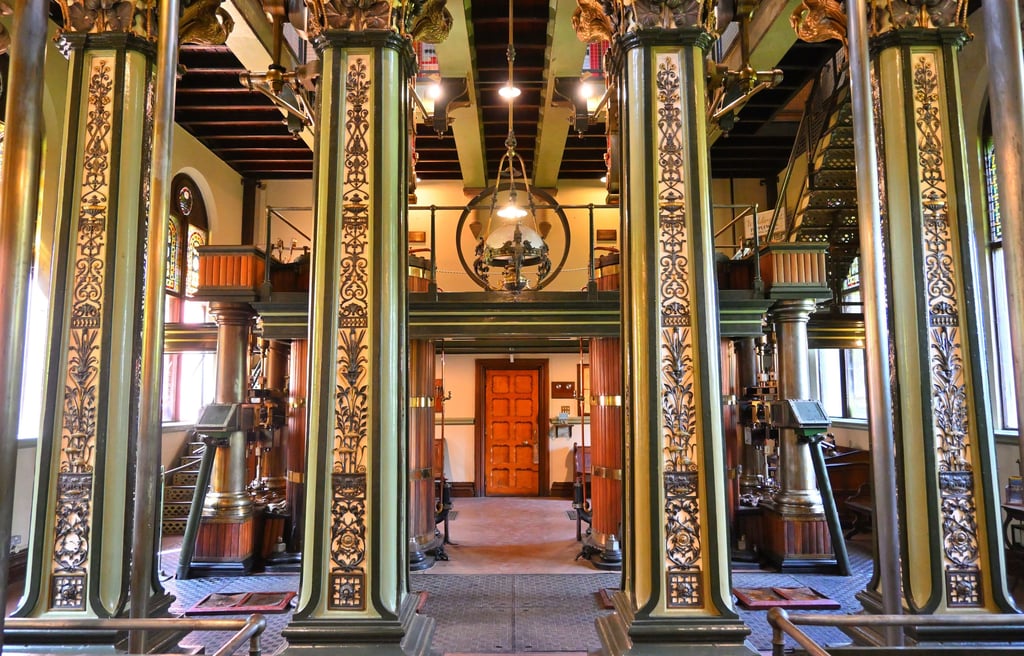
Architecturally, the interior pillars at Papplewick are mind-blowing. Out of all the historic waterworks we have visited, this is easily the most grand and ornate. The structural cast-iron columns feature elaborate metalwork decorations of freshwater fish, every single one uniquely carved.
From the specific angle of this photograph, you can’t see the fish detail directly as they are sculpted onto the lateral faces of the pillars, but the sheer scale of the gilded capitals and polished ironwork is stunning. Where other pumping stations were built with functional Victorian flair, Papplewick was constructed as a veritable temple to civic pride and clean water.
Photography Notes
Location: Papplewick Pumping Station, Ravenshead, Nottinghamshire, England.
Subject: Victorian Industrial Architecture & Steam Engine Beam Halls.
Shooting Industrial Brass and Cast Iron Indoors: Victorian engine houses are notoriously dark, lit by high arched windows that create intense side-lighting and deep shadows around heavy machinery. To avoid blown-out reflections on polished brass valves or gilded pillar caps, switch to Spot Metering or Center-Weighted Metering. Frame your shot to capture the repeating vertical lines of the cast-iron pillars, using the direction of the window light to emphasize the metallic textures without overexposing the surrounding brickwork.