
Wallaby Swarms and Squirrel Sprints: A Day at Peak Wildlife Park
PARKSQUIRRELWILDLIFE
Naturally, the wallabies vastly preferred being served at head height. Within seconds, I had an unruly, demanding queue on my hands—quite literally.
At one point, I had three or four wallabies simultaneously trying to wedge their snouts into my hand, tickling my palm as they jockeyed for position. Naturally, I tried to capture the madness one-handed with my camera.
It was utterly pointless. They were moving far too quickly, and a few of the more curious individuals decided to investigate the camera body directly. After five minutes of close-up encounters, I had to completely pull back and wipe down the front element of my lens, which had been thoroughly subjected to a series of damp wallaby nose smears.
Once the food finally ran out, they began gently using their claws to hoist themselves up to my chest height to check my pockets for hidden extras. It was a bit distracting while trying to compose a photograph, but immensely funny and well worth experiencing if you get the chance.
The Red Squirrel Autofocus Battle
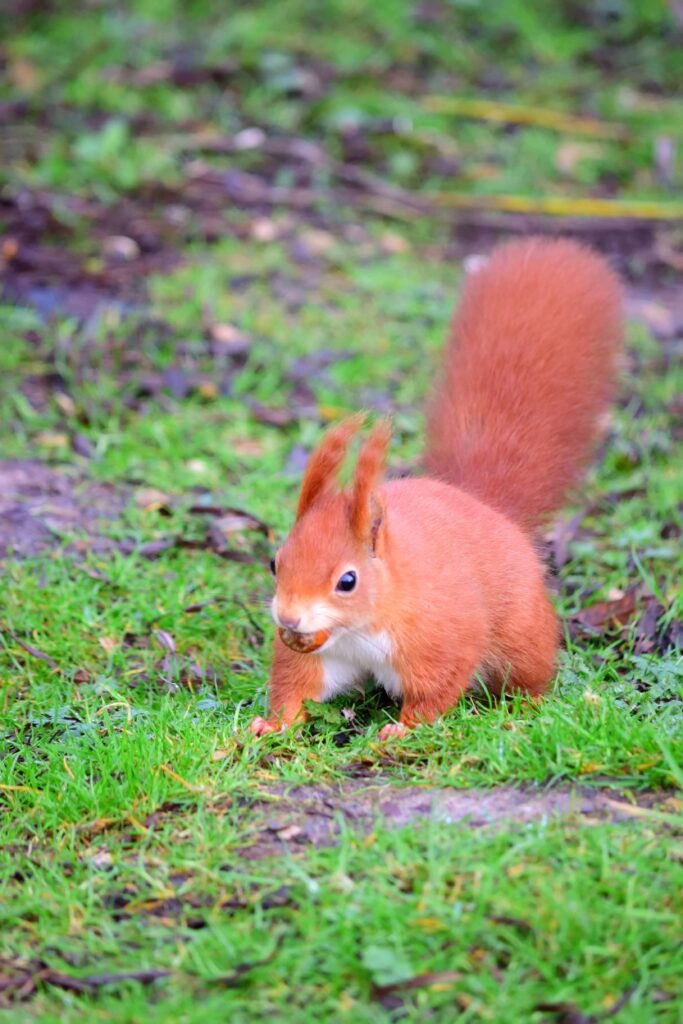
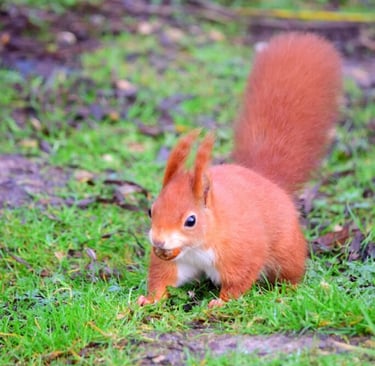
Needless to say, the featured photograph for this post isn't actually of a wallaby. Instead, it captures a hyperactive Red Squirrel busy stashing winter food.
The little chap was operating on a relentless loop: sprint to a feed box, grab a nut, dash off to bury it, and immediately zip back for another.
He was notoriously difficult to photograph. He moved with sudden, twitchy bursts of speed that easily outpaced my lens's autofocus tracking. In hindsight, I could have saved myself a lot of grief by stopping down my aperture to expand the depth of field and cranking the ISO up to compensate.
I lost at least two absolute print-worthy frames purely because the camera's autofocus firmly decided that the textured tree bark behind the squirrel was a far more deserving subject than the lightning-fast mammal itself!
Photography Notes
Location: Peak Wildlife Park, Winkhill, Staffordshire, England.
Subject: Interactive Wildlife & High-Speed Small Mammals.
Tackling Hyper-Fast Animals in Light Shade: Small woodland mammals like red squirrels shift directions in fractions of a second. When shooting fast-moving targets:
Switch your autofocus mode to Single-Point AF or Target Tracking rather than multi-zone wide AF. Multi-zone modes will almost always lock onto high-contrast background elements (like tree bark or leaves) instead of the animal's eye.
Keep your shutter speed at 1/1000s or faster to freeze sudden twitch movements.
Don't be afraid to push your ISO to 1600 or 3200 if you need to stop down to f/5.6 or f/8 to widen your focal margin of error.
If you are as old as I am, you will immediately know what the title of this post is referencing; if you aren't, I will leave it to Google to fill in the blanks.
This week we headed out to Peak Wildlife Park in Staffordshire. It is a relatively intimate, compact park, but it excels at immersive, "walk-through" exhibits featuring wallabies, squirrels, and lemurs. So long as you stay strictly on the designated pathways, you are sharing the exact same footprint as the animals.
The main highlight, however, is that you are allowed to hand-feed the wallabies.
While it wasn't quite as chaotic as our previous experience feeding alpacas, it was pretty close. I decided that feeding them directly from my palm was the heroic approach—unlike my wife, who promptly wimped out and threw her handful of feed onto the floor.