
Heavy on Politics, Light on Solutions: Ai Weiwei and the Irwell Reflection
MANCHESTERSALFORDFACTORY INTERNATIONAL
My primary grievance, however, was the overwhelming, heavy-handed moral lesson. The core takeaway seemed to be a resounding declaration that "war is bad"—a point so glaringly obvious it hardly needs to be made. Can we not skip the universal truisms and move on to concepts that actually push the conversation forward?
I felt a remarkably similar vibe at a previous Banksy exhibition. Both shows were extraordinarily heavy on political points and sweeping critiques of modern society, but remarkably light on how any of these complex issues should actually be solved.
Anyway, enough of my old-aged curmudgeonlyness.
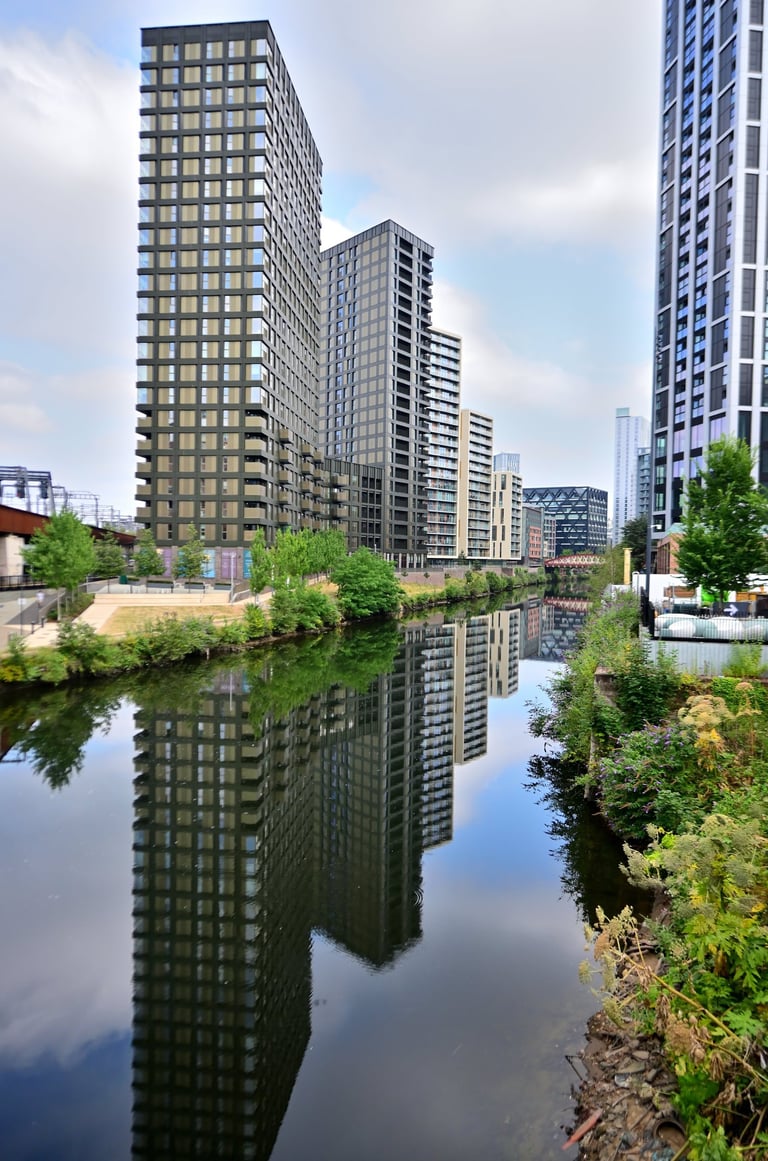
After leaving the exhibition hall, we took a stroll around the surrounding waterfront. As you cross the boundary bridge into Salford, you are greeted by a sweeping urban view along the River Irwell. Visually, I found the scene 100% perfect in one sense, yet somehow entirely frustrating as a photograph—a paradox I am still trying to fully unpack.
On this particular day, the River Irwell was dead calm, acting as a flawless, glass-like mirror. It reflected the clean lines of the Novella Apartments alongside a dozen other high-rise blocks stepping neatly into the background distance.
The reason the composition struggles to fully gel comes down to spatial dominance. The massive Union Co-Living building aggressively consumes the entire right side of the frame, accompanied by an unsightly patch of green scrub sprouting directly out of the concrete riverbank. Yet, if you attempt to crop those elements out to clean up the image, the entire photo becomes awkwardly lopsided.
It is one of those frustrating urban landscapes that would be vastly improved by taking a few steps back—an adjustment that is physically impossible unless you fancy getting your feet soaked in the Irwell or stepping off Prince's Bridge where the shot was taken.
It’s a bit of a pity, as there is undoubtedly a brilliant architectural shot hiding in that corridor from the right angle. Though perhaps next time, I'll turn the camera around and simply focus on the sheer, weird geometry of Factory International itself instead.
Behind the Lens: Urban Water Reflections
Artist's Note: Long, narrow urban river corridors (like the Irwell between Manchester and Salford) are a double-edged sword. When the water is completely still, the reflection doubles the visual information in your frame. If your background features strong architectural vertical lines, the reflection creates stunning symmetry. However, because you are often locked into a fixed position on a footbridge, you cannot easily change your height or distance to eliminate foreground clutter. When faced with an asymmetrical building dominating one side of the river, try using a polarizing filter. Rotating the polarizer allows you to selectively cut through or amplify the water's surface reflection, balancing the visual weight between the sky and the riverbed.
We headed over to Aviva Studios (Factory International) in Manchester to see the Ai Weiwei exhibition, and I think I have officially reached the point where I need to call it a day on contemporary art exhibitions.
I almost always walk away from these events feeling slightly frustrated, convinced that famous artists are operating in a completely different world from the rest of us. Don’t get me wrong: parts of the showcase were genuinely intriguing. The premise behind "The History of Bombs"—where individuals were given isolated blueprints to construct sections of the massive artwork without ever being shown the big picture—is a fascinating concept. It serves as a compelling analogy for industrial complex workflows, even if I felt the broader artistic message didn't quite hold up under scrutiny.